
One Model Replaces 300 — Unified Multi-Taxonomy Product Classification
$100K+/year saved
Summary
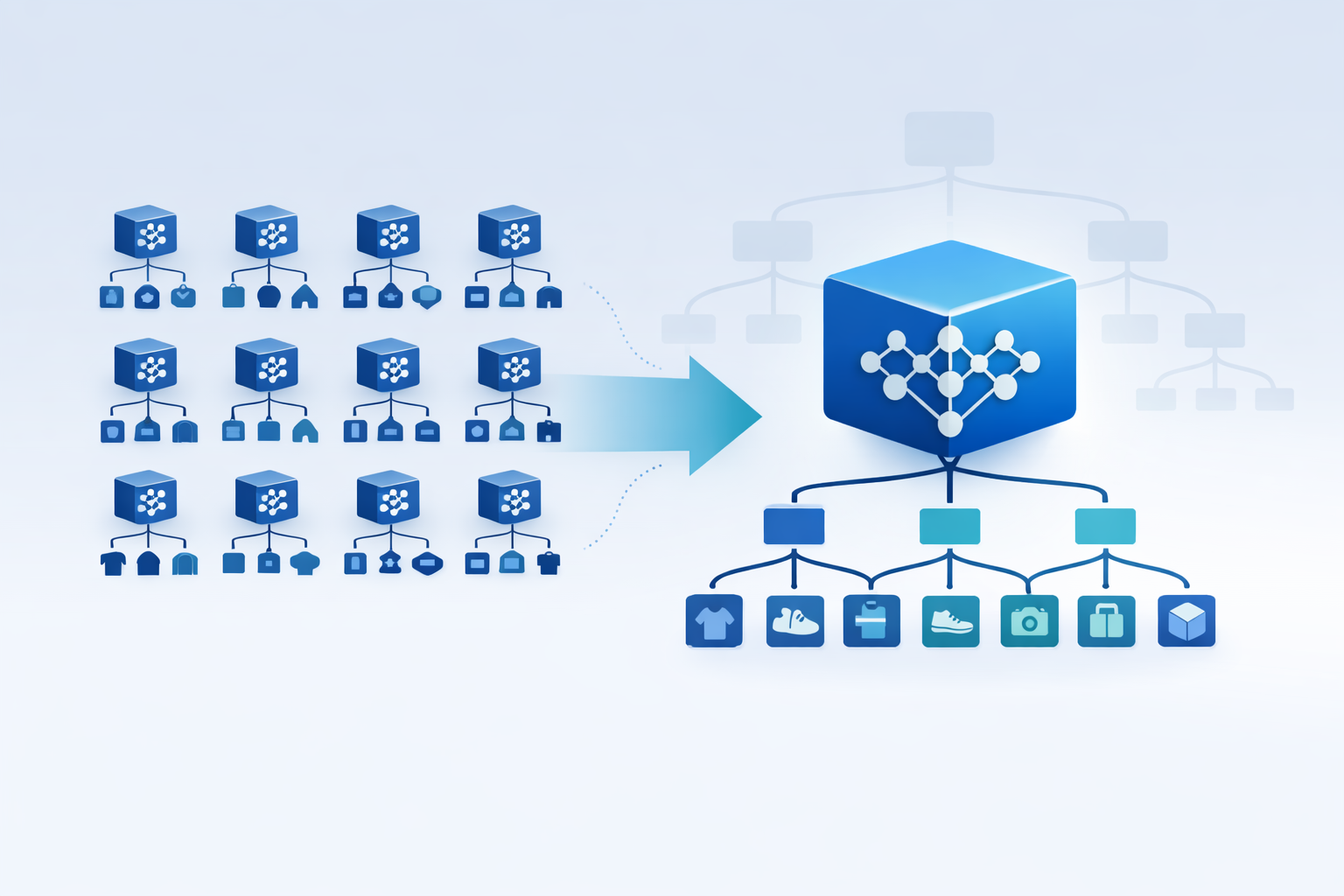
We designed and built a single ML model architecture that handles hierarchical product classification across multiple taxonomies, replacing 300 separate models that a global data intelligence company maintained for product categorization. The unified model reduced maintenance overhead dramatically and saved $100K+/year in infrastructure and operational costs.
Domain: Data Intelligence · E-Commerce Analytics Process type: ML architecture optimization; model consolidation; production system redesign
The Client Situation
A global data intelligence company had two business units — one covering North America, one covering Europe — each with its own product classification system and hierarchical taxonomy. The European unit alone maintained 300 separate ML models, one for each non-terminal node in the product taxonomy:
- Root → Health & Care, Books & Games, Electronics, ... (~300 categories at various levels)
- Each non-terminal node had its own dedicated classifier
- Each model needed separate training, monitoring, deployment, and maintenance
This created massive operational overhead: 300 models to retrain, 300 sets of metrics to monitor, 300 deployment pipelines. Any change to the taxonomy structure required updating multiple models and their dependencies.
What We Delivered
Single hierarchical model architecture We designed a model architecture that embeds the entire taxonomy hierarchy into one unified model. Instead of separate classifiers per node, the model learns the hierarchical structure and makes predictions at all taxonomy levels simultaneously.
Multi-taxonomy support The same architecture handles both business units' taxonomies (North American and European) despite their different structures and label sets. One model, multiple taxonomies — no duplication of infrastructure.
Production deployment The unified model runs in production, replacing the full fleet of 300 models with equivalent or better classification accuracy.
Outcome
We replaced 300 separate models with 1, saving $100K+/year in compute, storage, and maintenance costs. The unified architecture is simpler to maintain, faster to retrain, and easier to extend when the taxonomy changes. The same approach — embed hierarchy into the model rather than splitting into separate classifiers — applies to any organization with hierarchical classification needs (product catalogs, content taxonomies, medical coding, etc.).